At Todd Lake


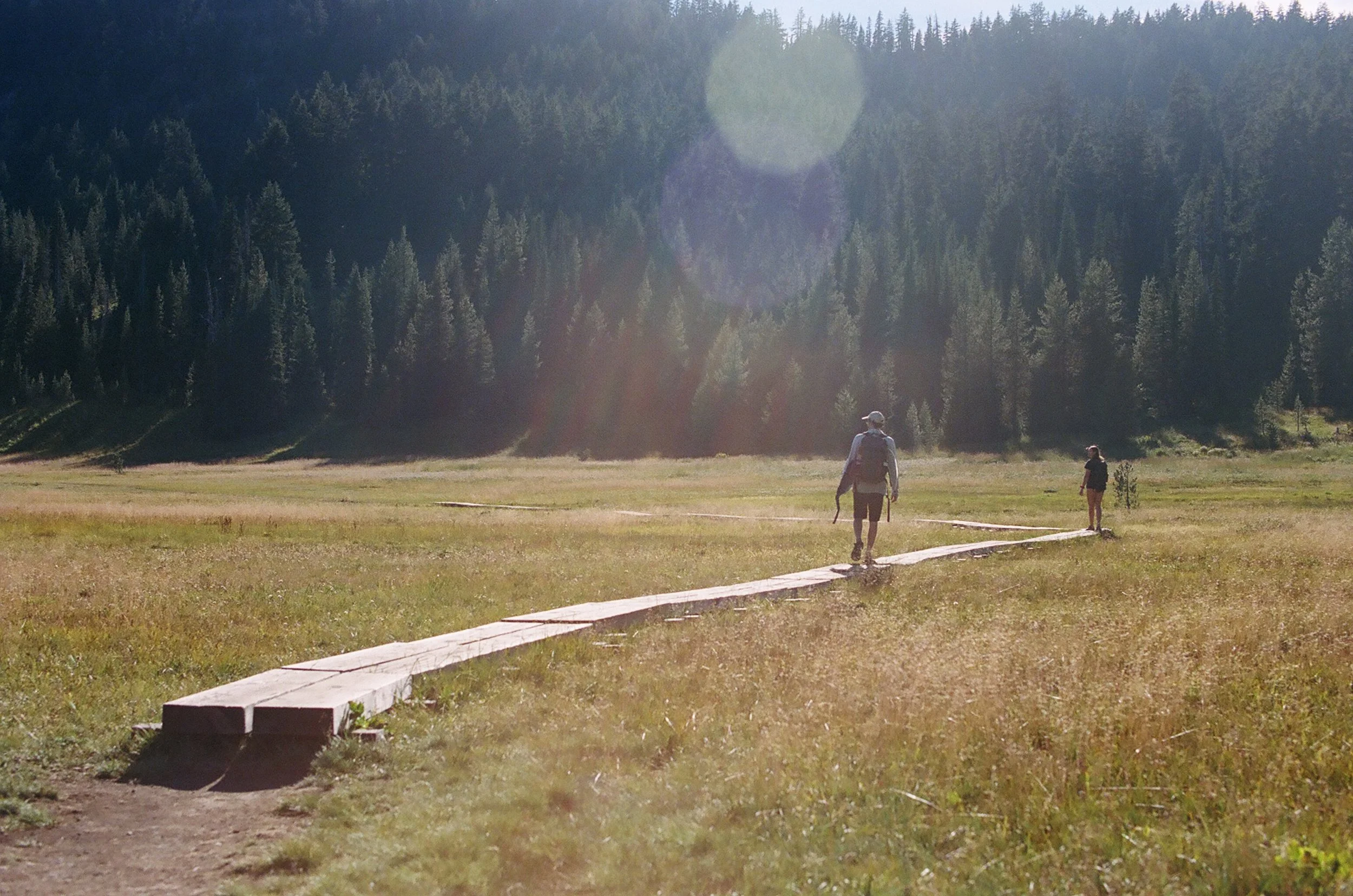
The thing about Todd Lake is that the water is warm, even though it’s a mountain lake, and it’s really shallow; you can still touch in the middle. So you can go out there even if you’re afraid of swimming, and you should, because the other thing about Todd Lake is that there’s a mountain on each end, and from the middle you can twirl and see both.
At one end of the lake (where you can see Mt. Bachelor) there’s a meadow, and in the meadow there’s a family, and in the family there’s these two kids. The kids are playing and yelling (or laughing? hard to tell) and from a distance they feel like Leo’s kids in Inception, which is to say they are perfect but also faceless. Like, it doesn’t matter who their parents are or what their life has been like or who they’ll grow up to be. From this distance, they’re just symbols for whatever it is we want children to embody; innocence, ignorance, joy?
Or maybe it isn’t the distance, but the place. It’s the kind of place that seems to exist outside of the world I know, and maybe outside of time, too. There’s just too much good here to leave any room for what I’ve been or what I’m going to be. There’s only one moment at a time. So while Noah and Maddy drift further down the boardwalk, I hang back, waiting for that tiny instant when they are about to become a part of the landscape—about to, but haven’t just yet.
Near the upper border


The sun goes down and comes up a few miles from the Canadian border, where they’ve cleared a swath 100 yards wide to mark the divide. No wall, but they’ve probably got sensors, Sam says, you know, for the draft runners. I mean, the covid dodgers. The runaways. Rule of thumb, don’t send your citizens scrambling for a better place.
Anyway, they let the bears go through. We’ve seen bear gouges on trees, bear poop on the trail, but no bears, yet. We did see a man, though; he appeared in our camp early in the morning. He wore flip flops duct-taped to his feet and didn’t carry any water. He was doing the whole trail in a few hours. He was there and gone. We packed up camp and brought the food down from the tree and got a move on; I sort of hoped we’d hit the valley stream before the real heat of the day, but we weren’t in a rush. Out here, how could we be?

Negative Capability: Let Uncertainty Be Your Guide
No one knows what lies ahead, and the current moment is a reminder of that; COVID has brought us face-to-face with the reality that our futures were never assured, that all our plans can be dashed overnight. Knowing this is frightening, because we want to be sure of things. We’d rather live in a world where we know our futures. But we don’t live in such a world, and pretending we do only sets us up for a harder time when the real future comes around to prove us wrong.
It’s an uncertain time, that’s for sure. If you’re a freelancer, a bit of uncertainty isn’t unusual. You’re probably used to the occasional empty calendar. But this isn’t run-of-the-mill uncertainty – this is new. We’ve completely lost our ability to predict what the rest of the year will look like, and the question has changed from, “What will my next job be?” to “What will the industry look like after this?”. We have nothing but speculation, which is often unsettling (and sometimes downright paralyzing).
Unfortunately, I can’t tell you when this will be over, or what the world will look like afterward. What I can offer is a perspective that’s been bringing me some solace over the last few months. It starts with the poet John Keats’s idea of Negative Capability.
Uncertainty is inherent to the artistic process, and Negative Capability is the name Keats gave to an artist’s ability to navigate that uncertainty. He described it as being “…when [an artist] is capable of being in uncertainties, mysteries, doubts, without any irritable reaching after fact and reason…” It’s an apt phrase, and though Keats himself never used it again, it’s stuck around.
We don’t often think of “reaching after fact and reason” as an irritable or unhelpful act, but if you’ve ever made art you know that sometimes too much of this can get in the way. Whether you write or paint, compose music or make films, you’ve probably gotten the sense that the whole process is one of exploration, during which you never quite know where your ideas are taking you. You may start with a structure as solid as concrete, but somewhere in the middle you’ll take a turn you didn’t expect and you’ll throw your whole outline out the window. Negative Capability is the ability of an artist to operate within that environment of mysteries and surprises. Keats believed this was the essential skill of the artist, because he knew that uncertainty is crucial to artistic creation.
Artists who possess Negative Capability are the ones who can work even when – and especially when – they don't know where they're going. To not know the future, and to not demand to know: it’s a kind of Zen that comes out of an honest understanding of the artistic process. As Annie Dillard says in her wonderful book The Writing Life:
“One of the things I know about writing is this: spend it all, shoot it, play it, lose it, all, right away, every time. Do not hoard what seems good for a later place in the book or for another book; give it, give it all, give it now… Something more will arise for later, something better.”
She’s urging the reader to go with the flow, to put what they’ve got on the page without worrying whether they’ll have anything to write later on. Don’t save your ideas, she says; believe that more will come. Steven Pressfield expresses a similar sentiment in Do the Work (another of my favorite books on art-making). “Trust the soup,” he says, the soup being that murky primordial pond from which all your ideas come crawling. In other words, trust your instincts.
If you’re an artist, that trust is key. You have to trust what comes out even if it’s not what you expect; you have to trust that the twists and turns are leading you somewhere good; and above all you have to trust in the uncertainty, because if you don’t accept it you’ll soon find yourself struggling pointlessly against it. How can you expect to know what you’re making if you haven’t finished making it yet?
They say every film is written three times, and this is why. When you write the film you have a certain vision in your head, but later, on set, you find the performances aren’t what you imagined, or the lines don’t quite work, or perhaps a whole scene needs to be re-thought, and so you change things; you rewrite. And then in post you do it again. You move things around, reorganizing the story to make it better. What comes out at the end is never what you imagined when you went in. Making a film is like walking down a trail without a map, without a clue how much further the trail goes or if it goes anywhere at all. Negative Capability is the filmmaker’s ability to keep putting one foot in front of the other despite the uncertainty. Negative Capability is knowing that you don’t know, but trusting that you’ll figure it out as you go along.
And really, this is a lot like living life right now. We can never predict the future, but somehow we get it in our heads that we can. And then, from nowhere – a pandemic hits.
No one knows what lies ahead, and the current moment is a reminder of that; COVID has brought us face-to-face with the reality that our futures were never assured, that all our plans can be dashed overnight. Knowing this is frightening, because we want to be sure of things. We’d rather live in a world where we know our futures. But we don’t live in such a world, and pretending we do only sets us up for a harder time when the real future comes around to prove us wrong.
Besides discomfort and anxiety, what does an acceptance of uncertainty offer? It offers, I think, the freedom to move forward fearlessly, just as accepting uncertainty in the artistic process allows you to continue creating without fear that your delicate plan will fall apart. Trusting the creative process is the same as having hope in life. Having hope is acknowledging that the future might be bad, or it might be good, and then choosing to believe that it will be good. But hope isn’t passive. It isn’t empty optimism. Like making art, it requires action – it requires you to live your belief in a good future. If this seems like a hard thing to do right now, just think of all the moments you’ve lost hope in some project you’ve done.
I imagine a painter in her studio at night, staring in disgust at a half-finished portrait. “What comes next?” she asks. “Why did I ever begin? Is it terrible and I don’t know it?” But the painter, I imagine, doesn’t throw her painting in the trash bin, as much as she’d like to. Instead she reminds herself that she’s asking questions she can’t possibly answer. She reminds herself that her painting might well be terrible, but it just as well might be great, and that there’s only one way to find out. And so, she takes those unanswerable questions and she bundles them up and stands on the stool and stuffs them in the back of a high shelf and leaves them there. And then she gets back to work.
Our lives are unfinished portraits. Sometimes we can envision every stroke, but sometimes it’s not so easy. Sometimes life happens and we sit for hours in the studio in despair. The thing to do then is to bring your own Negative Capability out into your life, to put those unanswerable questions on the shelf and keep going. You don’t need to answer them ever, and certainly not now. The thing now is to remember that the future could be good – and then do your best to make it so.

A Tale of Two Park Cities: In the Shadow of Sundance, Slamdance is Warmer
But Slamdance isn’t trying to be Sundance–far from it. A few minutes after Paul’s history lesson, he says something totally unexpected which proves to me that this festival, held yearly in Sundance’s shadow, is a completely different beast. Paul says we are all going to stand up and introduce ourselves–all 150 of us, one by one.
Treasure Mountain Inn, Park City, Friday, Jan 24th, 5:30 pm
At the opening night filmmaker welcome for the 2020 Slamdance Film Festival, one of the founders, Paul Rachman, took up the microphone and told us about the origins of the festival: “In 1995, a few of us had had our films rejected by Sundance, but we came here anyway, determined to screen them. And we did.”
What started as an expression of frustration and perseverance has since become a highly regarded festival in its own right. This year Slamdance received 8,500 submissions, well over half of Sundance’s yearly submissions (and because Slamdance programs fewer films, its acceptance rate is actually lower than that of its elite cousin).
But Slamdance isn’t trying to be Sundance–far from it. A few minutes after Paul’s history lesson, he says something totally unexpected which proves to me that this festival, held yearly in Sundance’s shadow, is a completely different beast. Paul says we are all going to stand up and introduce ourselves–all 150 of us, one by one.
It’s a bit like the first day of 5th grade, and it takes a while, but it’s not boring. It’s actually kind of beautiful. “Look around,” Paul says, “See each other, meet each other, see each other’s films, support each other. Slamdance is a community, and you’re all a part of it.”
Down the street, all week
Community is important because working as a filmmaker is often isolating. From writing to producing to post-production, we spend a lot of time alone or nearly alone in front of computer screens–and at no point in the journey is success anywhere near assured. In fact, it’s unlikely. In the face of that uncertainty we have to be our own marketing team, our own megaphone, and this can go on for years. Years grappling with a script, searching for money to shoot it, arranging and rearranging footage, all while plagued by incessant doubt about whether it’s any good at all.
Meanwhile, examples of success in film are inescapable: the people who have found success in this industry make up a great swath of our popular culture. But while Hollywood’s exterior is an object of cultural awe, those who hope to break into the industry find it absolutely opaque.
This actually feels more true in Park City during Sundance than even in Los Angeles the rest of the year. Hillary Clinton and Taylor Swift aside, Park City was awash in Hollywood names this year: Ethan Hawke, Daveed Diggs, Elisabeth Moss, Eva Longoria, Taylour Paige, Tessa Thompson, Anne Hathaway, Alec Baldwin, Glenn Close, Mila Kunis, Christopher Abbott, Carey Mulligan, Rachel Brosnahan, Evan Rachel Wood, Logan Lerman, and on— it seemed like every actor in Hollywood was there, not to mention the producers, the financiers, the agents, each name a possible ticket to the big-time.
But as it turns out, tight geographic proximity to the stars and producers and distribution execs only amplifies the feeling of there being an invisible and impenetrable wall; all the parties have lists, most of the sponsored lounges are exclusive, and celebs are only seen as they’re ushered from events to SUVs. Netflix’s lounge featured papered-over windows and a sign on the door that read “Access by Appointment Only.” And truly, there’s no better image for the industry’s exclusivity than a couple of indie filmmakers shivering on Main Street, just outside a private party in the WME Lounge for which they are not on the list.
This is not to say that Sundance isn’t where every indie filmmaker wants to end up. Sundance remains the king of the American film festivals, and for good reason. But in a year when HBO, Hulu, Disney+, and Searchlight all premiered films under that prized Sundance glow and Netflix alone owned eleven Sundance films before the festival even began, one begins to suspect that we cannot simply call the festival “indie” and leave it at.
Back up the street
To the ambivalence of the festival down the street, Slamdance was a worthy antidote. In the opening night slot, Lynne Sachs premiered her documentary Film About a Father Who. Lynne, who is more artist than filmmaker (she held an intimate poetry reading at a bookstore on Main a few days after her premiere, and she paints, too!), is the antithesis of Sundance glamor. Confident and in the heart of a long and prolific career, it’s obvious Lynne cares about her art, not her renown.
I don’t believe Hollywood artists care more about their fame than their art, but they certainly operate within a culture that does, and as a result are whisked away to after-parties as soon as their screenings finish. I wouldn’t want to be mobbed by rabid fans either, but as a young filmmaker there’s something unambiguously authentic and nurturing about a festival where one can find the filmmaker right there in the lobby after her screening, answering questions and saying hello.
Nurturing is what Slamdance is all about. It’s about the filmmakers, and you can feel it: during shorts blocks, individual Q&As are held after each film instead of as a group at the end, panels are free and open to the public, and Slamdance invites its filmmakers to program the festival the following year (a tradition which contributes enormously to the festival’s indie integrity).
Even when it comes to the awards, Slamdance remains community-oriented. As was mentioned by two Slamdance winners at the awards ceremony this year, the environment wasn’t competitive; it was always supportive. Support is the culture of the fest, and it pours down from the founders and the staff and animates everyone. As a result, Slamdance networking is networking not upward but outward. It’s making friends.
And that’s important. Festivals and other industry events can sometimes devolve into a game of upward career mobility, but Slamdance doesn’t give you the opportunity to forget what it’s really about. “Slamdance is a community, and you’re all a part of it,” we were told that first night, and the room softened. 150 filmmakers, who for so long walked their own paths, had finally come together. A fellow filmmaker said it best, in the moments after the welcome: “I just want to hug everyone.”
Elevator

The elevator stopped somewhere between the 35th and 36th floors. After 15 minutes had passed he finally looked at her and said, "Isn't this something?" She replied, "I would prefer if we didn't speak." As the night fell and the rain began to fall and the night staff replaced the day staff he decided to sit, to slide down the side of the elevator onto the ground, even though he knew it made him look weak.
After two days had passed and no one had come she said "Perhaps it would be okay if we were to talk," but by then he had forgotten how.